


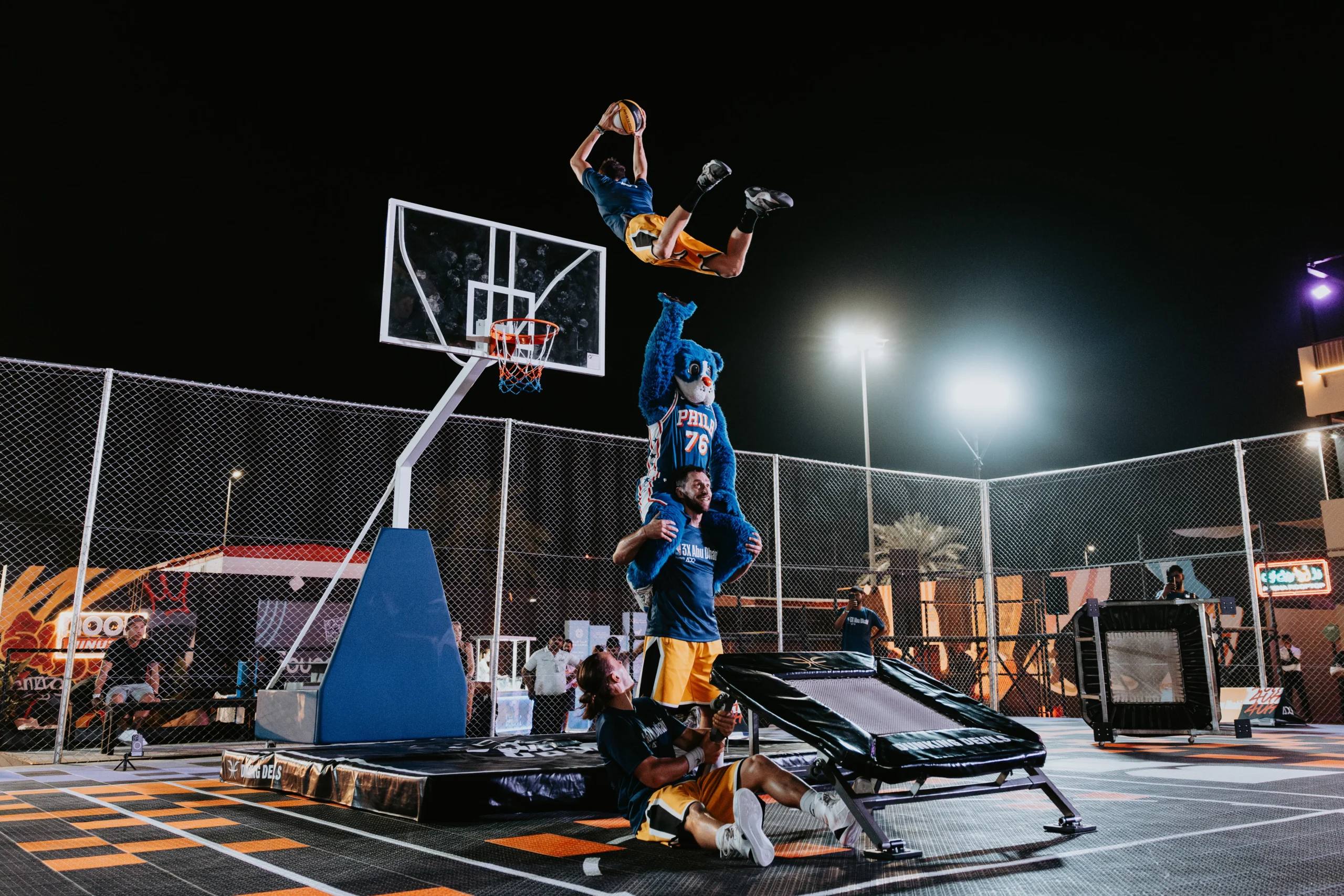
What is acrobatic basketball?
Acrobatic basketball, also known as acrobatic dunking, combines basketball, gymnastics and acrobatics into a high-energy discipline built around spectacular trampoline-assisted dunks. Athletes use trampolines to launch themselves towards the basketball hoop, combining flips, twists, passes and dunks into precisely timed sequences.
The basics
How does acrobatic dunking work?
Acrobatic dunkers use a basketball hoop, basketballs and specially positioned trampolines to gain the height and airtime needed to perform acrobatic skills before finishing with a dunk.
A typical professional performance combines 4–8 athletes, with each sequence relying on timing, precision and teamwork. Athletes may perform individually, in synchronized formations or in combinations where the basketball is passed between several team members before the final dunk.
The result combines the athleticism of basketball with elements of gymnastics and acrobatics to create a fast, highly visual discipline designed to be experienced live.
The history
From American halftime shows to a global discipline
The roots of modern acrobatic basketball can be traced to the United States around 1980, when a group of University of Mississippi cheerleaders began combining basketball, gymnastics and mini-trampoline acrobatics during basketball games.
One of the defining early moments came in 1980, when Ole Miss cheerleader Ty Cobb performed a flip from a mini-trampoline into a slam dunk during a basketball game against Alabama.
The group continued developing the concept by combining acrobatics, basketball handling, passes and increasingly complex trampoline-assisted dunks. The act soon moved beyond college basketball and into professional arenas, including NBA games.
The professional group became known as the Dixie Daredevils in 1983 and, following sponsorship, the Bud Light Daredevils from 1984.
The Bud Light Daredevils went on to perform at college and NBA basketball games across the United States and internationally, helping establish trampoline-assisted acrobatic dunking as a recognizable form of basketball entertainment.
Early acrobatic basketball

Early acrobatic basketball — Bud Light Daredevils
Three generations. One evolving sport.
The evolution of acrobatic basketball
-
~1980USA
The beginning
The roots of modern acrobatic basketball can be traced to the University of Mississippi (Ole Miss), where athletes began combining basketball, gymnastics and mini-trampoline acrobatics during basketball games.
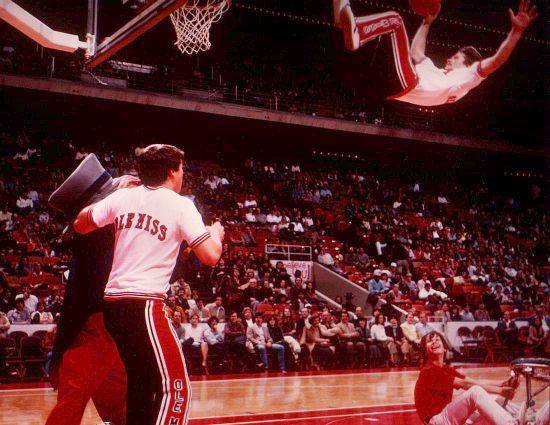
Ole Miss-era acrobatic basketball — archival photograph -
1980Ole Miss
The flip dunk
Ty Cobb performs an early documented flip from a mini-trampoline into a slam dunk during an Ole Miss basketball game against Alabama, helping shape the concept of trampoline-assisted acrobatic dunking.
-
Early 1980s
From college to NBA arenas
The group develops increasingly complex routines combining mini-trampolines, flips, basketball passes and dunks. The act expands from college basketball into professional NBA arenas.
-
1983USA
Dixie Daredevils
The professional touring group becomes known as the Dixie Daredevils, developing acrobatic basketball into a dedicated live entertainment act.
-
1984USA
Bud Light Daredevils
Following sponsorship, the group becomes the Bud Light Daredevils. Their performances help establish trampoline-assisted acrobatic dunking as a recognizable form of basketball halftime entertainment in the United States and internationally.
Watch the early footage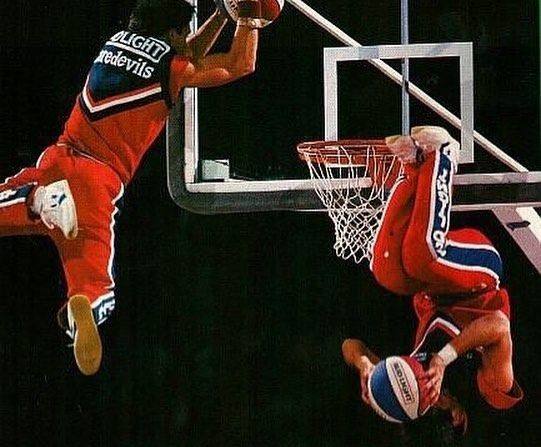
Bud Light Daredevils — archival photograph -
1991Slovenia
Žabe
A new chapter begins in Ljubljana with the formation of Žabe. With strong roots in gymnastics, Žabe become pioneers of acrobatic dunking in Slovenia, combining basketball, acrobatics, choreography and entertainment.
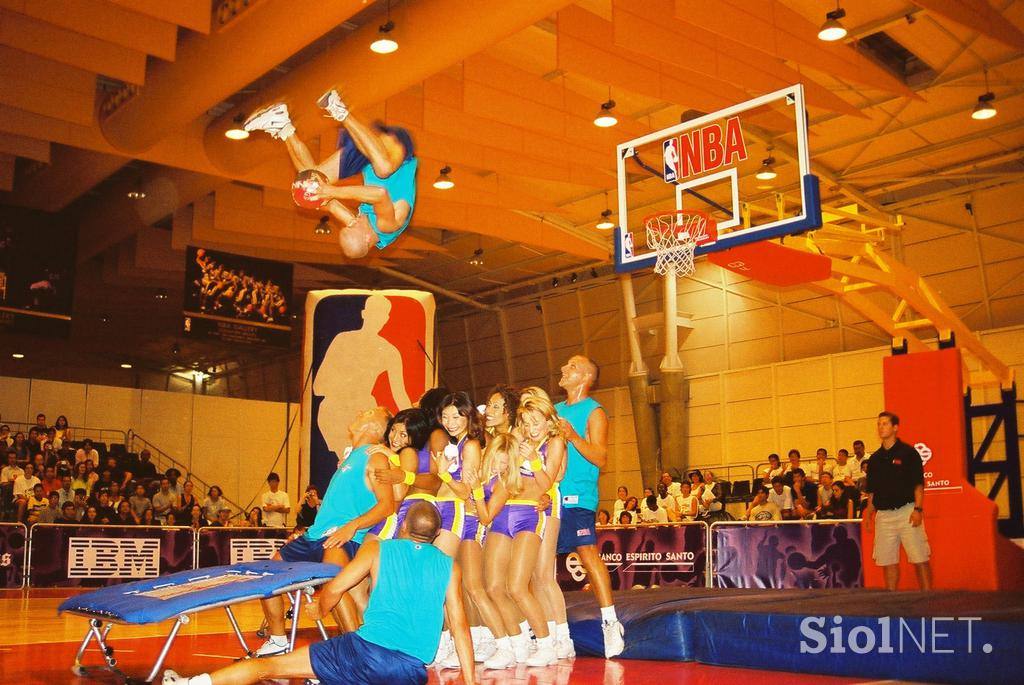
Žabe — archival photograph · Photo: Siol.net -
30 November 1991
First Žabe performance
Žabe perform for the first time at a basketball game between Olimpija mladi and Domžale in Slovenia.
-
1993
Žabe go international
Only two years after their first performance, Žabe begin receiving opportunities to perform internationally, taking Slovenian acrobatic dunking beyond the country’s borders.
-
1998
Žabe in Chicago
Žabe reach one of the biggest stages of their era, performing in Chicago during the Chicago Bulls’ final championship season with Michael Jordan.
-
Late 1990s / early 2000s
The next generation
The knowledge and experience of Žabe begin influencing a new generation of Slovenian acrobats. A former Žabe member becomes an important coach and mentor, including through the group Bakros, connecting Slovenia’s first generation of acrobatic dunkers with the generation that follows.
-
2004Ljubljana
Dunking Devils
The core of Dunking Devils begins operating as a team. They train together, develop new acrobatic basketball skills and tricks, attract new members and perform at local basketball clubs and schools.
-
2004 → Today
Dunking Devils go global
What begins on local basketball courts develops into an international professional acrobatic basketball team. Dunking Devils expand the sport through new tricks, performance formats, competitions, major international shows and increasingly ambitious projects.
-
2016
World Champions
Dunking Devils win the World Championship title in acrobatic dunking.
-
2018
World Champions again
Dunking Devils win their second World Championship title, confirming their position among the leading teams in modern acrobatic dunking.
-
Today
A global sport & entertainment form
From its early development in American basketball arenas, through the Bud Light Daredevils and Slovenia’s Žabe, to the next generation represented by Dunking Devils, acrobatic basketball has evolved into both an athletic discipline and a form of live entertainment performed around the world.
- 3,500+ shows
- 58 countries
- 5 continents
- 2× World Champions
- 2× Guinness World Records
- 500M+ online views
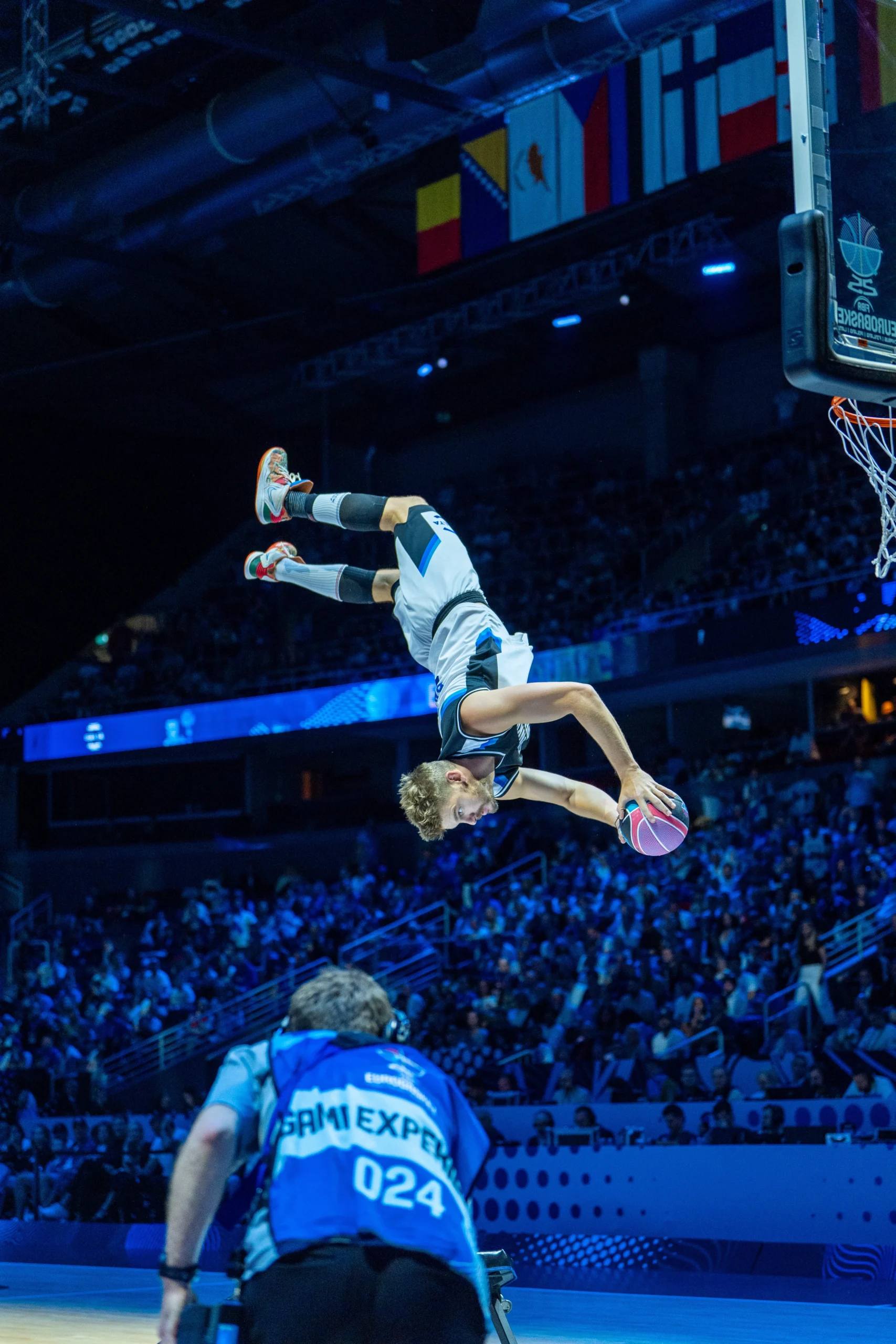
Dunking Devils today
The timeline shows how the sport evolved across generations; it does not describe one continuous organisation.
The Slovenian story
1991 — Žabe bring acrobatic dunking to Slovenia
An important new chapter began in Slovenia in 1991 with Žabe, a Ljubljana-based acrobatic group with strong roots in gymnastics. Žabe combined technically demanding acrobatics with basketball, choreography, improvisation and entertainment.
Their first performance took place on November 30, 1991, at a basketball game between Olimpija mladi and Domžale. By 1993, the group was already receiving opportunities to perform internationally.
Many of the members came from gymnastics, and the group became an important pioneer of acrobatic dunking in Slovenia. One of their most memorable international appearances came in Chicago in 1998: Žabe performed in Chicago during the Chicago Bulls’ final championship season with Michael Jordan.
Inspiring the next generation
The influence of Žabe extended beyond their own performances. A former Žabe member later became an important coach and mentor within Slovenia’s acrobatic community and worked with athletes who would become part of the Dunking Devils story.
Domen Gaiman (Rozman), one of the key figures behind Dunking Devils, has described joining the acrobatic group Bakros as a teenager. This created a direct connection between Slovenia’s early generation of acrobatic dunkers and the generation that would later develop Dunking Devils.
- Žabe
- Next generation of Slovenian acrobats
- Dunking Devils

Žabe acrobatic group — archival footage
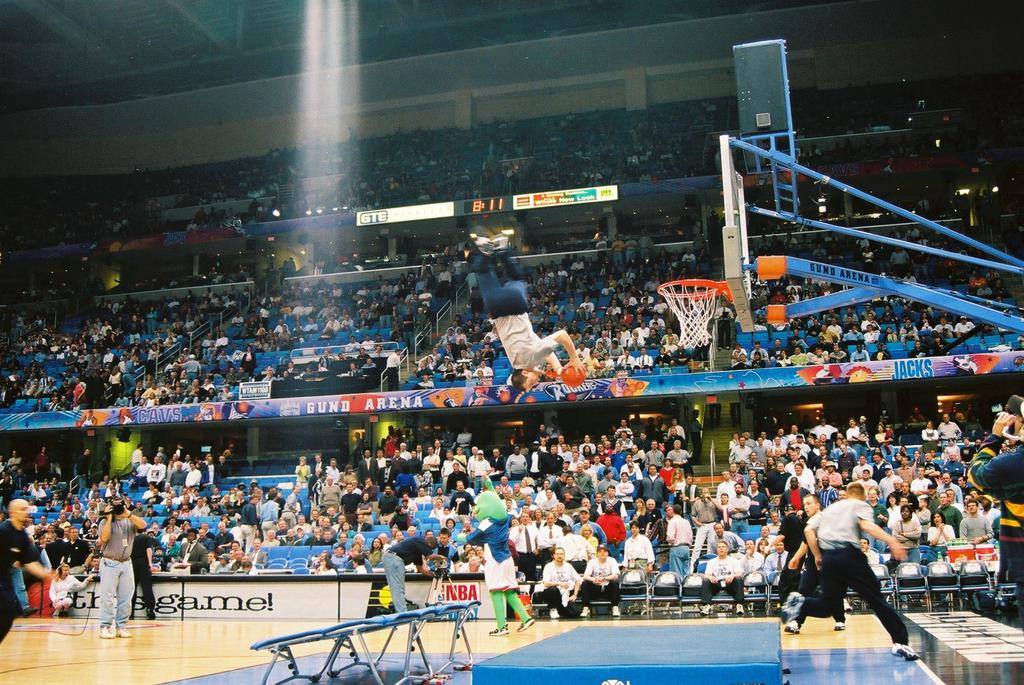
The next generation
2004 — Dunking Devils begin their story
In 2004, the core of what would become Dunking Devils began operating as a team in Slovenia — training together, developing the sport, attracting new members and performing at local basketball clubs and schools.
Inspired by the generations before them, the team continued pushing acrobatic basketball through new tricks, combinations, performance formats and increasingly ambitious projects. What started on local basketball courts grew into an international professional team.
Today, Dunking Devils have performed more than 3,500 shows in 58 countries across five continents. The team is a two-time World Champion in acrobatic dunking and its members hold two Guinness World Records in trampoline-assisted slam dunking.
The elements
More than just a dunk
Flips & twists
Forward flips, backflips, twists and combinations are performed in the air before the athlete reaches the basket.
Passes
Multiple athletes combine acrobatics with precisely timed basketball passes to create sequences ending in a spectacular dunk.
Synchronization
Team routines require athletes to coordinate their approach, trampoline take-off, flight path and timing.
Creativity
New combinations, formations and tricks continuously push the possibilities of acrobatic dunking.
From sport to show
Built for basketball. Made for live entertainment.
Acrobatic dunking has been connected to basketball entertainment since its earliest days. Its combination of basketball, athleticism and spectacle makes it particularly suited to short, high-impact moments during live games.
Today, acrobatic basketball appears at basketball games, major sports events, corporate events, festivals, brand activations and live productions around the world. Dunking Devils adapt the format to different moments of a basketball game.
Basketball entertainment can also include audience animation during game breaks using t-shirt cannons and t-shirt slingshots.
Explore basketball game entertainment- 2–5 min
Pregame
Acrobatic dunk show that opens the night before tip-off.
- 90 sec
Quarter break
Fast acrobatic dunk performance between quarters.
- 45 sec
Timeout
Compact, high-impact dunk sequence during a timeout.
- 5–7 min
Halftime
The main acrobatic basketball show.
Acrobatic basketball vs. Acrobatic Dunk Show
Acrobatic basketball, or acrobatic dunking, describes the athletic discipline itself: athletes use trampolines, basketballs and a basketball hoop to perform acrobatic dunks, passes and combinations.
An Acrobatic Dunk Show takes those skills and transforms them into a choreographed entertainment product designed for live audiences and events.
Dunking Devils’ standard Acrobatic Dunk Show typically features 4–8 performers and can be adapted to a 7–15 min performance format depending on the event.
Explore the Acrobatic Dunk ShowPushing the limits
Guinness World Records
-
Highest forward flip trampoline slam dunk
3.55 m / 11.64 ft
Achieved by Maks Veselko, member of Dunking Devils, in Cyprus (Nicosia), on 17 December 2016.
-
Farthest forward flip trampoline slam dunk
8.33 m / 27.33 ft
Achieved by Jaka Komloš, member of Dunking Devils, in Ljubljana, Slovenia, on 4 September 2022.

Acrobatic basketball FAQ
What is acrobatic basketball?
Acrobatic basketball is a discipline combining basketball, gymnastics and acrobatics. Athletes use trampolines to perform flips, twists, passes and other aerial skills before finishing with a basketball dunk.
Is acrobatic basketball the same as acrobatic dunking?
The terms are commonly used to describe the same type of activity. “Acrobatic dunking” emphasizes the dunking discipline, while “acrobatic basketball” more broadly describes the combination of basketball and acrobatics.
When did acrobatic basketball begin?
The roots of modern acrobatic basketball can be traced to the United States around 1980, when University of Mississippi athletes began combining basketball, gymnastics and mini-trampoline acrobatics during basketball games.
Who were the Bud Light Daredevils?
The Bud Light Daredevils were an American acrobatic basketball group that developed from an act created by University of Mississippi athletes in the early 1980s. They became known for combining gymnastics, mini-trampolines, basketball passes and spectacular dunks at college and NBA basketball games.
Who were Žabe?
Žabe were a Slovenian acrobatic group formed in Ljubljana in 1991. With strong roots in gymnastics, they became pioneers of acrobatic dunking in Slovenia and influenced the generation of Slovenian acrobats that followed.
When did Dunking Devils begin?
The core of Dunking Devils began operating as a team in Slovenia in 2004, developing acrobatic basketball, attracting new members and performing at local basketball clubs and schools before expanding internationally.
How many athletes perform in an acrobatic dunk team?
Team sizes vary, but Dunking Devils’ professional Acrobatic Dunk Show typically features 4–8 performers depending on the event and performance format.
Can acrobatic basketball be booked for events?
Yes. Dunking Devils perform acrobatic basketball internationally at basketball games, sporting events, corporate events, festivals, brand activations and other live productions.
Bring the next chapter of acrobatic basketball to your event
From basketball halftime shows to full Acrobatic Dunk Shows, Dunking Devils bring more than two decades of experience and generations of acrobatic basketball development to live audiences around the world.